

Why is Healthcare in China 90% Cheaper Than in the U.S.?
A Deep Dive Research Guide
Chapter 1: The Global Healthcare Gap—Data vs. Reality
To understand medical pricing in China, one must first recognize a broader context: the global disparity in healthcare costs is extreme.
Many international observers experience profound "sticker shock" when first encountering Chinese medical bills. On platforms like YouTube and Reddit, users frequently share stories of getting an MRI in China for less than $100, while the same procedure in the United States could cost thousands. For those unfamiliar with the system, this gap seems almost incomprehensible.
However, within the framework of global healthcare structures, the reasons become clear. Prices are not determined solely by technology; they are shaped by systemic factors including insurance models, government regulation, hospital operations, and market competition.
Healthcare Expenditure as a Percentage of GDP
According to data from the OECD and the World Health Organization (WHO), national healthcare systems generally fall into three categories: highly market-driven, government-led, or hybrid. The U.S. represents the market-driven extreme, while China operates a hybrid model with strong government oversight.
| Country | Healthcare Spending (% of GDP) |
|---|---|
| United States | 17% |
| Germany | 12.8% |
| France | 12.2% |
| Japan | 10.9% |
| United Kingdom | 10.2% |
| China | 5.6% |
While the U.S. spends nearly three times as much of its GDP on healthcare as China, higher spending does not always equate to better outcomes. The Commonwealth Fund consistently ranks the U.S. system as one of the most expensive yet least efficient among developed nations in terms of equity and accessibility.
Direct Price Comparisons
When looking at specific services, the price gap is startling. Data from public databases and international medical tourism agencies highlight the following average ranges:
| Procedure | Average Price (U.S.) | Average Price (China) |
|---|---|---|
| MRI Scan | $1,200 – $3,000 | $70 – $200 |
| CT Scan | $500 – $2,000 | $30 – $120 |
| General Consultation | $100 – $300 | $2 – $15 |
| Blood Tests | $100 – $500 | $10 – $50 |
| Full Physical Exam | $500 – $2,000 | $50 – $300 |
In many cases, Chinese medical costs are only 5% to 15% of their American counterparts. This extends to inpatient care; a hospital stay in the U.S. can cost $2,000 to $5,000 per day, whereas a general ward in a top-tier Chinese hospital may cost only a few dozen to a few hundred dollars.
Chapter 2: Viral Shock—The Social Media Perspective
As expatriates and travel vloggers document their lives in China, content featuring healthcare experiences has gone viral on YouTube and Reddit. These real-world accounts often highlight two main shocks: price and speed.
The "Price Anchoring" Effect
In psychology, the price anchoring effect occurs when people rely on the first piece of information they learn to judge value. Americans are "anchored" to believe an MRI must cost over $1,000. When they see a bill for $70, their first reaction isn't relief—it's suspicion.
One Reddit user shared their experience in Shenzhen, getting an MRI for roughly 500 RMB (approx. $70) within hours of walking in. The comments were a mix of disbelief and frustration: "If this is true, our system is fundamentally broken," wrote one user.
Efficiency: The Second Shock
In many Western countries, the "Gatekeeper System" requires an appointment with a primary care physician followed by a referral to a specialist. This can lead to weeks or months of waiting. China operates on a Direct Access Model, where patients can often walk into a major hospital, register, and receive specialist consultation and imaging on the same day.
Chapter 3: Decoding the Cost Structure
Why is the price so low? It is a combination of scale, regulation, and labor costs.
1. Economy of Scale and High Throughput
Top-tier (Grade 3A) hospitals in cities like Beijing and Shanghai handle 10,000 to 30,000 outpatients per day.
In economics, high-volume systems reduce unit costs. An MRI machine costing $2 million is expensive if it serves 10 patients a day, but if it runs 100 scans a day, the cost per patient plummets. Chinese hospitals maximize equipment utility through sheer volume.
2. Government-Regulated Pricing
Basic medical services—consultations, routine tests, and standard treatments—are subject to strict government price caps to ensure affordability. While premium services exist, the floor for basic care remains exceptionally low by international standards.
3. Physician Compensation and Administrative Costs
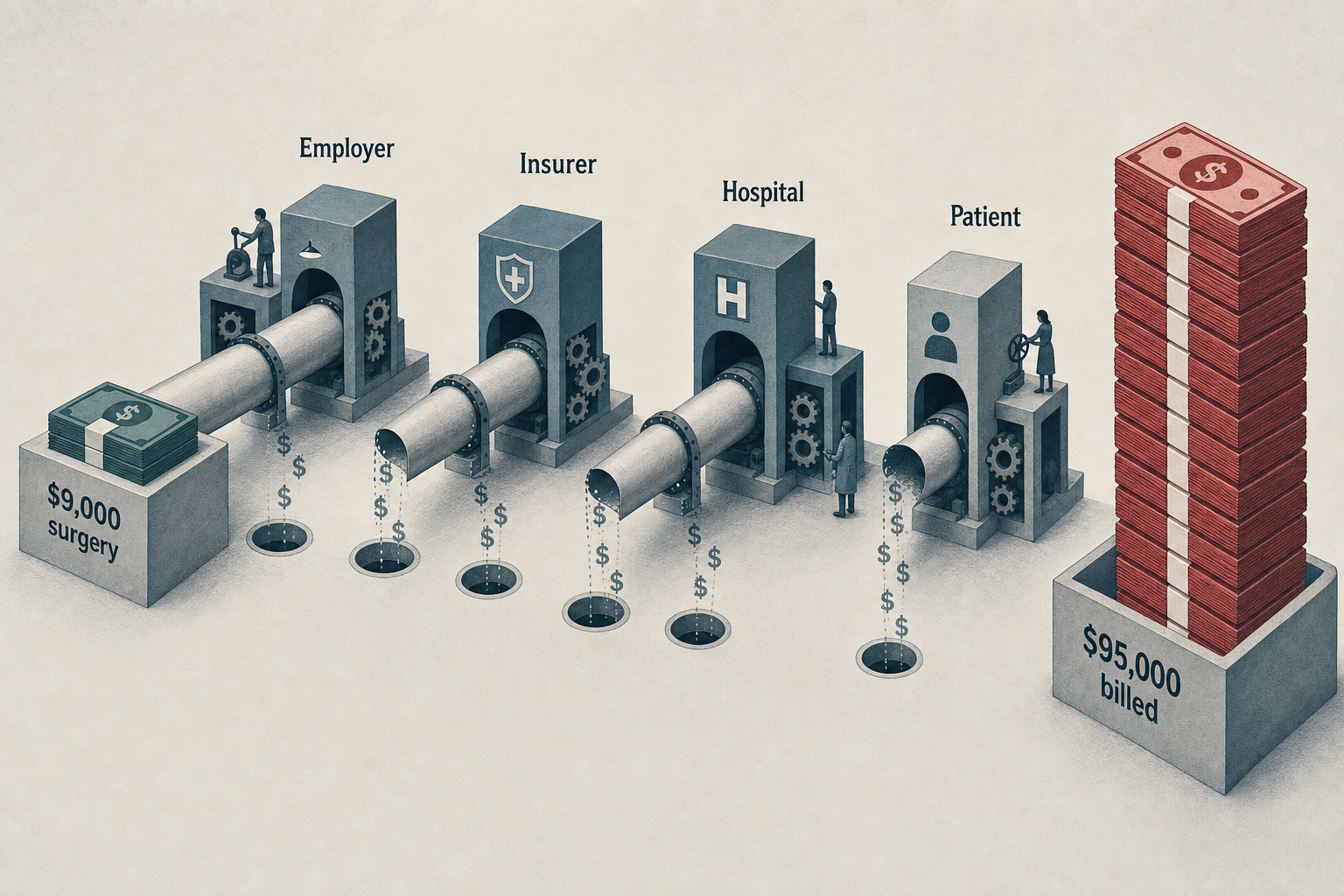
In the U.S., specialist salaries often reach $300,000–$500,000. While Chinese doctors are highly skilled, their base salaries in public hospitals are significantly lower. Furthermore, the U.S. system spends over 20% of its budget on administration (billing, insurance negotiations, and legal compliance). China's simpler administrative structure significantly reduces overhead.
Chapter 4: Does Low Cost Mean Low Quality?
A common misconception is that low prices imply inferior care. However, China’s top-tier hospitals are equipped with state-of-the-art technology and staffed by doctors who have often trained globally.
While there is a disparity between elite urban hospitals and rural clinics, the technical proficiency in major medical centers—such as Peking Union Medical College Hospital or Ruijin Hospital in Shanghai—is world-class. The price difference reflects systemic cost-control and socioeconomic factors rather than a lack of medical expertise.
Chapter 5: The Rise of Medical Tourism in China
Three distinct groups of international patients are increasingly choosing Chinese healthcare:
- Expatriates: Foreign professionals living in China who prefer the efficiency and lower costs of international departments in local hospitals.
- Medical Tourists: Patients traveling specifically for specialized procedures, such as minimally invasive surgeries or Traditional Chinese Medicine (TCM) integration.
- High-End Specialized Patients: Those seeking advanced treatments, including robotic surgeries or innovative cancer clinical trials.
According to the China Hospital Association, over 850 medical institutions now offer dedicated international services, with growing numbers of patients seeking orthopedics, cardiac surgery, and oncology.
Comparison of Common Costs
| Service | China (RMB) | U.S. (USD) | Notes |
|---|---|---|---|
| MRI | 486 | $2,000–$3,000 | Includes imaging report |
| Bunion Surgery | 8,000 | $15,000–$20,000 | Minimally invasive |
| Acupuncture | 200–500 | N/A | Per session |
Chapter 6: Future Trends and International Impact
Looking ahead to 2030, China is poised to become a major global medical destination. Key drivers include:
- Digital Integration: Remote consultations and international payment gateways (like international credit card support via Alipay) are making the process seamless.
- Policy Support: The government is simplifying "Medical Visas" and improving international insurance direct-billing systems.
- AI-Driven Efficiency: AI-assisted diagnosis is further reducing wait times and increasing accuracy.
Summary
For international patients, China offers a compelling value proposition: high efficiency, advanced technology, and costs that are 1/5th to 1/10th of those in the West. As transparency increases and word-of-mouth spreads via social media, China is evolving from a regional player into a global powerhouse for affordable, high-quality medical care.